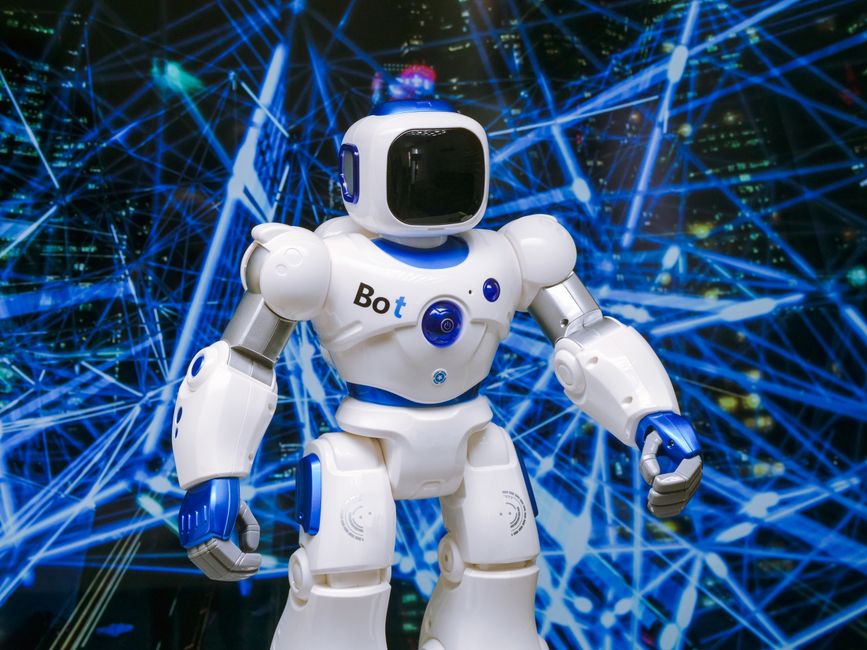
Imagine a world where robots aren't just programmed to follow strict instructions, but can actually learn, adapt, and even make decisions on their own. Sounds like science fiction, right? Well, thanks to Artificial Intelligence (AI), this future is rapidly becoming our present! From self-driving cars navigating busy Indian streets to robotic assistants helping in our homes, AI is the secret sauce that’s transforming clunky machines into smart, capable companions. At MakerWorks, we believe understanding this powerful combination of AI and robotics is key to unlocking the innovations of tomorrow. So, let's dive into the fascinating world where robots get their 'brains'!
What Exactly is Artificial Intelligence?
At its heart, Artificial Intelligence is about making machines think and learn like humans. Instead of just following a fixed set of commands, AI allows robots to process information, recognize patterns, solve problems, and even understand natural language. Think of it this way: traditional robots are like highly skilled chefs who can only cook dishes from a recipe book. AI-powered robots are like chefs who can invent new recipes, adapt to different ingredients, and even learn from their mistakes to cook better next time!
AI isn't a single technology; it's a broad field encompassing many techniques. The most crucial one for robotics is:
Machine Learning: How Robots Learn
Machine Learning (ML) is a core branch of AI that gives robots the ability to learn from data without being explicitly programmed for every single scenario. Instead of writing millions of lines of code for every possible situation a robot might encounter, we feed it vast amounts of data, and it learns to identify patterns and make predictions or decisions based on that data.
- Supervised Learning: This is like learning with a teacher. We give the robot input data along with the correct output. For example, showing it thousands of pictures of cats and dogs, telling it which is which, until it learns to identify them on its own.
- Unsupervised Learning: Here, the robot learns on its own without explicit labels. It finds hidden patterns or structures in data, like grouping similar objects together without being told what those groups should be.
- Reinforcement Learning: This is like learning through trial and error, similar to how a child learns to walk. The robot performs an action, gets a 'reward' for good actions and a 'penalty' for bad ones, and adjusts its behavior to maximize rewards over time. This is particularly powerful for training robots to navigate complex environments or play games.
Neural Networks: The Brains of the Operation
A significant breakthrough in Machine Learning came with Neural Networks (NNs), especially Deep Learning. Inspired by the human brain's structure, neural networks are layers of interconnected "neurons" (mathematical functions) that process information. They are incredibly good at tasks like:
- Image Recognition: Helping robots "see" and understand what's around them – identifying objects, people, and obstacles.
- Speech Recognition: Enabling robots to understand spoken commands and even engage in conversations.
- Pattern Detection: Finding complex patterns in data that humans might miss, crucial for predictive maintenance or anomaly detection in industrial robots.
These neural networks allow robots to perceive their environment in sophisticated ways, making them much more intelligent and adaptable.
How AI Makes Robots Smarter: Key Capabilities
AI transforms robots from simple automatons into intelligent systems with a range of advanced capabilities:
- Enhanced Perception: AI-powered cameras and sensors allow robots to "see" and "hear" their surroundings with incredible accuracy. They can identify objects, track movement, and even recognize faces or emotions. This is vital for tasks like picking specific items from a conveyor belt or navigating safely through a crowded room.
- Intelligent Navigation & Mapping: Instead of following pre-programmed paths, AI enables robots to build maps of their environment (SLAM - Simultaneous Localization and Mapping), locate themselves within those maps, and plan optimal routes while avoiding obstacles. This is how delivery robots navigate complex building layouts or autonomous vehicles find their way.
- Advanced Decision Making: AI allows robots to analyze sensory data and make complex decisions in real-time. Should it pick up the red ball or the blue one? Should it turn left or right to avoid a collision? These decisions are made dynamically, adapting to changing circumstances.
- Natural Interaction: With Natural Language Processing (NLP), robots can understand human speech and even respond in a natural way. This opens up possibilities for intuitive human-robot collaboration in homes, hospitals, and workplaces.
- Continuous Learning and Adaptation: One of the most exciting aspects is the ability of AI robots to learn from experience. They can improve their performance over time, adapting to new tasks or environments without needing a complete reprogramming.
"The greatest impact of AI will not be in creating super-intelligent robots that replace us, but in augmenting human capabilities and solving problems we never thought possible." – Fei-Fei Li
AI in Action: Real-World Robotics Examples
AI isn't just a concept; it's actively powering robots across various sectors:
- Manufacturing: Collaborative robots (cobots) work alongside humans, using AI to understand human gestures, ensure safety, and adapt to varying tasks like assembly, welding, or quality inspection.
- Healthcare: AI-driven surgical robots assist doctors with precision, while companion robots provide support to the elderly, and hospital delivery robots navigate corridors to transport medicines.
- Logistics & Warehousing: Autonomous Mobile Robots (AMRs) use AI to navigate warehouses, sort packages, and transport goods, significantly speeding up operations.
- Exploration: From Mars rovers analyzing geological data to underwater drones mapping ocean floors, AI helps these robots make autonomous decisions in extreme, remote environments.
- Agriculture: AI robots can precisely monitor crop health, identify weeds, and even pick ripe fruits, leading to more efficient and sustainable farming.
- Education: Robots like those you build at MakerWorks, integrated with AI, can serve as engaging tools to teach coding, problem-solving, and STEM concepts interactively.
A Peek into the Code: Simple AI Logic
While complex AI involves deep neural networks, even simple decision-making logic can be considered a form of AI. Here's a very basic Python example of how a robot might decide to move based on sensor input:
# This is a very simplified example to show basic AI decision-making
# In a real robot, sensor data would be much more complex,
# and decisions would involve more sophisticated ML models.

def robot_decision_maker(sensor_data):
    """
    A simple function for a robot to decide its action based on sensor input.
    """
    obstacle_distance = sensor_data.get('front_obstacle_distance', 100) # Default to 100cm
    traffic_light_color = sensor_data.get('traffic_light', 'green')
    battery_level = sensor_data.get('battery_percentage', 80)

    if battery_level < 20:
        print("Battery low! Initiating recharge sequence.")
        return "recharge"
    elif obstacle_distance < 30: # If an obstacle is less than 30cm away
        print(f"Obstacle detected at {obstacle_distance}cm! Stopping and re-planning path.")
        return "stop_and_replan"
    elif traffic_light_color == 'red':
        print("Traffic light is red. Waiting.")
        return "wait"
    else:
        print("Path clear. Moving forward.")
        return "move_forward"

# Simulate sensor data
current_sensor_data_1 = {
    'front_obstacle_distance': 15,
    'traffic_light': 'green',
    'battery_percentage': 75
}

current_sensor_data_2 = {
    'front_obstacle_distance': 60,
    'traffic_light': 'red',
    'battery_percentage': 85
}

current_sensor_data_3 = {
    'front_obstacle_distance': 80,
    'traffic_light': 'green',
    'battery_percentage': 15
}

print("--- Robot Scenario 1 ---")
robot_decision_maker(current_sensor_data_1)

print("\n--- Robot Scenario 2 ---")
robot_decision_maker(current_sensor_data_2)

print("\n--- Robot Scenario 3 ---")
robot_decision_maker(current_sensor_data_3)
This simple code demonstrates how a robot can take different actions based on different inputs, simulating a basic level of "intelligence." Real-world AI in robotics uses far more complex algorithms and massive datasets, but the core idea of making decisions based on perceived information remains.
The Future is Now: Why AI in Robotics Matters for You
The convergence of AI and robotics is not just a technological trend; it's a revolution shaping our future. For students and young innovators in India, understanding this field opens up a world of opportunities:
- Exciting Career Paths: From AI engineers and robotics scientists to data analysts and machine learning specialists, the demand for skilled professionals in this domain is skyrocketing.
- Problem Solving: AI-powered robots can help us tackle some of the world's biggest challenges, from sustainable agriculture and disaster relief to personalized education and healthcare accessibility.
- Innovation & Creativity: Learning about AI and robotics empowers you to build your own smart devices, create solutions, and turn imaginative ideas into tangible realities.
Getting Started with AI & Robotics at MakerWorks
At MakerWorks, we believe that the best way to understand AI in robotics is by doing! We provide the tools, resources, and guidance for you to get hands-on experience. Whether you're building your first line-following robot, experimenting with basic machine learning algorithms, or diving into more advanced projects, we're here to help you:
- Explore our workshops: Learn the fundamentals of robotics, programming, and AI.
- Build with our kits: Get hands-on experience assembling and programming your own smart robots.
- Join our community: Connect with fellow enthusiasts, share ideas, and collaborate on exciting projects.
The journey into AI and robotics is an adventure filled with discovery. It's about empowering machines to see, think, and act, and in doing so, empowering ourselves to create a smarter, more efficient, and more exciting world. Don't just observe the future; build it!
Are you ready to give your robots a brain? Visit MakerWorks and start your AI & Robotics journey today!