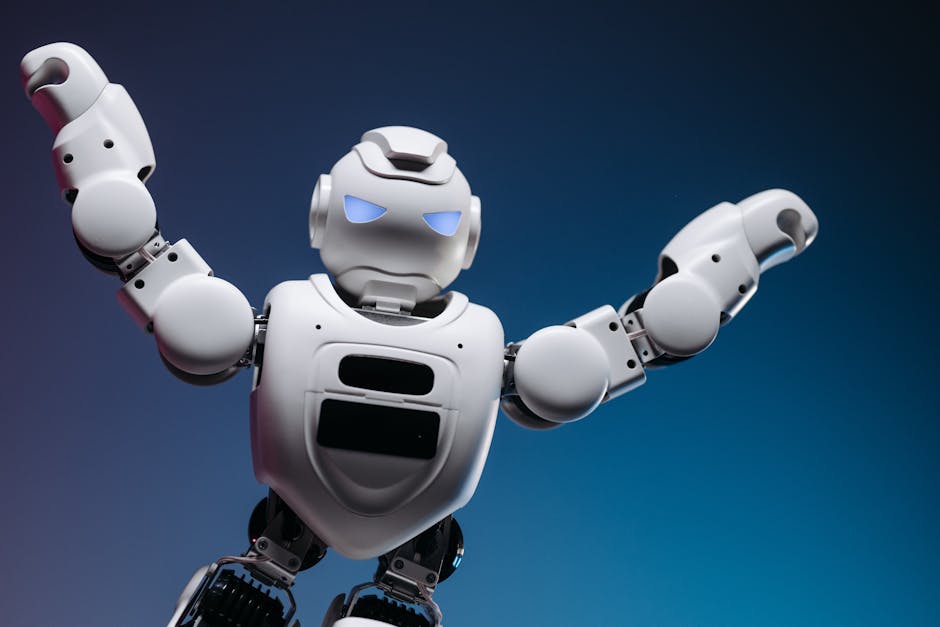
Imagine teaching a puppy new tricks. You don't just program it with lines of code; you guide it with treats and gentle corrections. It tries, it fails, it learns. What if robots could learn the same way? Welcome to the fascinating world of Reinforcement Learning (RL), where robots aren't just programmed, they're trained to make smart decisions on their own, much like you learn from your own experiences!
What is Reinforcement Learning? The Robot's School of Hard Knocks
At its core, Reinforcement Learning is a type of machine learning where an "agent" (our robot) learns to make decisions by interacting with its "environment." Think of it as a continuous cycle of trial and error, guided by a system of rewards and penalties.
Unlike traditional programming, where you explicitly tell a robot every step, RL lets the robot discover the best actions through feedback. The robot performs an action, observes the outcome, and receives a "reward" (or a "penalty") based on how good or bad that outcome was. Over time, it learns which actions lead to the biggest rewards in different situations.
Key Components of an RL System:
- Agent: The learner and decision-maker (our robot!).
- Environment: The world the agent interacts with (a factory floor, a maze, a game board).
- State: The current situation or configuration of the environment (e.g., robot's position, sensor readings).
- Action: A move or decision made by the agent (e.g., move forward, pick up an object, turn left).
- Reward: A numerical feedback signal from the environment, indicating the desirability of an action (positive for good, negative for bad).
"Reinforcement Learning is about learning what to do—how to map situations to actions—so as to maximize a numerical reward signal." - Richard S. Sutton & Andrew G. Barto
Why RL is a Game-Changer for Robotics
Traditional robot programming often involves meticulously writing instructions for every possible scenario. This works for simple, repetitive tasks in controlled environments. But what happens when the environment changes unexpectedly? What if an object isn't exactly where it's supposed to be, or a new obstacle appears?
This is where RL shines. It allows robots to:
- Adapt to Dynamic Environments: Robots can learn to navigate cluttered spaces, handle variations in objects, or adjust to changing conditions without explicit reprogramming.
- Solve Complex Problems: For tasks with an enormous number of possible states and actions (like playing complex games or driving a car), traditional programming is impossible. RL can discover optimal strategies.
- Achieve True Autonomy: By learning from experience, robots can make independent decisions, reducing the need for constant human supervision.
- Discover Novel Solutions: Sometimes, the robot's trial-and-error might lead to unexpected, yet highly efficient, ways of solving a problem.
How Do Robots Learn? The Magic of Rewards and Q-Tables
Let's dive a little deeper into how this learning happens. Imagine our robot is trying to find its way through a maze to a target location.
The Reward System: Guiding the Way
The reward system is crucial. The robot gets a positive reward for reaching the target and a negative reward (penalty) for hitting a wall or taking too long. It might get a small negative reward for each step taken, encouraging it to find the shortest path.
The robot's goal isn't just to get one reward; it's to maximize its cumulative reward over time. This encourages it to think strategically about future actions.
Exploration vs. Exploitation: Balancing Curiosity and Knowledge
Early on, the robot needs to "explore" – try different paths, even seemingly bad ones, to discover what works. As it gains more experience, it starts to "exploit" its knowledge – choosing the actions it knows lead to higher rewards.
A good RL algorithm balances these two. Too much exploration, and it might never find the best path. Too much exploitation, and it might miss better, undiscovered solutions.
The Q-Table: A Robot's Memory of Good Moves
One of the simplest and most foundational RL algorithms is Q-Learning. It uses something called a "Q-table." Imagine this as a big spreadsheet where the robot keeps track of the "quality" (Q-value) of taking a particular "action" from a given "state."
Initially, all Q-values are zero. As the robot explores and receives rewards, it updates these values. If an action in a certain state leads to a high reward, that Q-value increases. If it leads to a penalty, it decreases.
Here's a simplified conceptual example of how a Q-table might be updated for a robot in a tiny 2x2 grid trying to reach a goal (G) from a start (S):
# Simplified Q-table update logic (conceptual Python-like pseudocode)
# Q_table = { (state, action): Q_value }
# Example states: 'S1', 'S2', 'S3', 'S4' (representing grid cells)
# Example actions: 'move_up', 'move_down', 'move_left', 'move_right'
# Initialize Q-table (all values to 0)
Q_table = {}
for state in ['S1', 'S2', 'S3', 'S4']:
for action in ['move_up', 'move_down', 'move_left', 'move_right']:
Q_table[(state, action)] = 0.0
# Define rewards (e.g., reaching goal = +10, normal step = -1)
rewards_map = {
('S4', 'move_down'): 10 # Assuming S4 is near goal, 'move_down' reaches it
# Other moves might have -1 or -5 for hitting a wall etc.
}
# During training (after taking action 'a' from 's', observing reward 'r' and new state 's_prime'):
# old_q_value = Q_table[(s, a)]
# max_future_q = max(Q_table[(s_prime, action)] for action in possible_actions_from_s_prime)
# # The core Q-learning update formula: