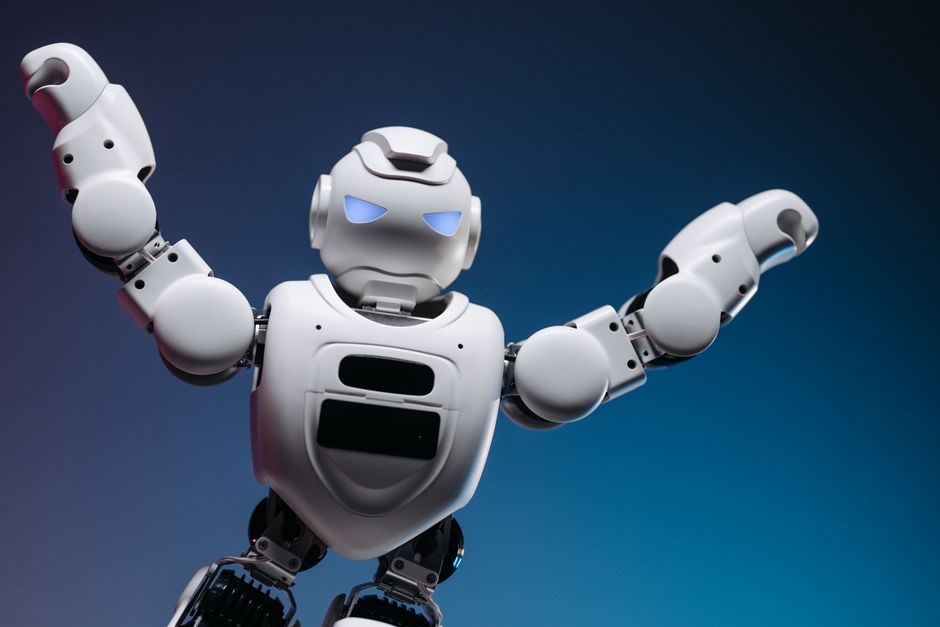
Imagine a robot that isn't just following pre-programmed instructions, but actually learns from its mistakes, just like you do! What if a robot could figure out the best way to solve a puzzle or navigate a complex obstacle course, all by itself? This isn't science fiction anymore; it's the exciting world of Reinforcement Learning (RL), and it's revolutionizing how we train robots right here, right now.
What is Reinforcement Learning? The "Trial and Error" for Robots
At its heart, Reinforcement Learning is a type of machine learning where an "agent" (our robot) learns to make decisions by performing actions in an "environment" and receiving "rewards" or "penalties" for those actions. Think of it like teaching a pet a new trick:
- You give a command (the robot takes an action).
- If the pet does it right, you give it a treat (a positive reward).
- If it does it wrong, you might ignore it or give a gentle "no" (a negative reward or penalty).
- Over time, the pet learns to associate certain actions with treats and avoids actions that don't lead to treats.
Robots using RL follow a similar principle. They try different things, observe the outcomes, and adjust their strategy to maximize positive rewards over time. This allows them to learn complex behaviors without being explicitly programmed for every single scenario.
How Does RL Work in Robots? A Dance Between Agent and Environment
For a robot to learn using RL, there's a continuous loop of interaction:
- Observation: The robot "sees" or senses its current situation (its "state") in the environment.
- Action: Based on its current understanding (its "policy"), the robot decides what to do next.
- Reward: The environment responds to the robot's action, giving it a positive reward (if the action was good), a negative reward (if it was bad), or a neutral reward.
- Learning: The robot uses this reward feedback to update its policy, making it more likely to repeat actions that led to positive rewards and less likely to repeat those that led to negative ones.
This cycle repeats countless times, allowing the robot to gradually improve its performance and achieve its goals autonomously.
Key Components of Reinforcement Learning
Let's break down the essential elements that make RL tick:
- Agent: This is our robot! It's the learner and decision-maker.
- Environment: This is the world the robot operates in. It could be a simulated virtual space or the real physical world.
- State: The current situation or configuration of the environment as perceived by the agent. For a robot navigating a room, the state might include its position, the location of obstacles, or the goal.
- Action: A move or operation the agent can perform within the environment. For a robotic arm, actions could be "move up," "grip," or "release."
- Reward: A numerical value that tells the agent how good or bad its last action was. The agent's ultimate goal is to maximize the total reward it receives over time.
- Policy: This is the agent's strategy or rulebook. It dictates what action the agent should take in any given state. Initially, the policy might be random, but it gets refined through learning.
"Reinforcement learning is the closest machine learning paradigm to how humans and animals learn – through interaction and feedback."
Why RL is Different: Beyond Programmed Instructions
You might be wondering, "Why not just program the robot?" While traditional programming is excellent for tasks with clear, predictable steps, RL shines in situations where:
- The environment is complex and dynamic: Think of a robot navigating a cluttered, changing room. Programming every possible obstacle and interaction would be impossible.
- The optimal solution isn't known beforehand: Sometimes, even humans aren't sure of the best strategy. RL allows the robot to discover novel, efficient ways to solve problems.
- Adaptability is crucial: An RL robot can adapt its behavior if the environment changes slightly, whereas a traditionally programmed robot might fail.
Real-World Applications: Where RL Robots are Making a Mark
Reinforcement Learning isn't just a theoretical concept; it's powering incredible advancements:
- Robotics for Logistics: Robots in warehouses use RL to optimize routes for picking and placing items, making operations faster and more efficient.
- Autonomous Driving: While not fully reliant on RL, components of self-driving car systems use RL to learn optimal navigation strategies, lane keeping, and decision-making in complex traffic scenarios.
- Robotic Manipulation: Industrial robots are learning delicate tasks like grasping oddly shaped objects or assembling intricate parts, adapting to slight variations in position or form.
- Robotics in Gaming and Simulation: RL is extensively used to train AI agents to play complex games like Chess, Go, or even video games, often achieving superhuman performance. This helps develop robust learning algorithms before deploying them in the real world.
A Glimpse into RL: A Simple Learning Loop (Pseudocode)
To give you a clearer idea, here’s a simplified conceptual example of how a robot might learn to navigate a grid to reach a goal:
# Simplified Reinforcement Learning Loop for a Robot in a Grid World

# 1. Initialize our robot agent and the grid environment
robot_agent = initialize_robot_with_random_policy()
grid_environment = create_grid_environment(goal_position=(4,4), penalty_for_wall=-10)

# We'll let the robot learn over many "episodes" (attempts)
num_learning_episodes = 1000

for episode in range(num_learning_episodes):
    current_state = grid_environment.reset_robot_position() # Robot starts at a new position
    goal_reached = False
    total_reward_this_episode = 0

    while not goal_reached:
        # a. Agent observes its current location (state)
        # b. Agent chooses an action (e.g., move_up, move_down, move_left, move_right)
        #    based on its current "policy" (what it thinks is best)
        action = robot_agent.choose_action(current_state)

        # c. Environment executes the action and tells the robot:
        #    - What the new state is
        #    - How much reward it got for that action
        #    - If the goal has been reached
        new_state, reward, goal_reached = grid_environment.perform_action(action)

        # d. Agent learns from the reward and updates its policy
        #    (e.g., if it got a good reward, it makes that action more likely from that state)
        robot_agent.learn_from_experience(current_state, action, reward, new_state)

        current_state = new_state # Move to the new state
        total_reward_this_episode += reward

    print(f"Episode {episode+1}: Total Reward = {total_reward_this_episode}")

# After many episodes, the robot's policy will be optimized to reach the goal efficiently,
# avoiding walls and taking the shortest path to maximize its total reward!
This pseudocode shows the fundamental loop: observe, act, get feedback, and learn. With enough iterations, the robot gets smarter!
The Future is Autonomous: Your Role in It!
Reinforcement Learning is a powerful tool that gives robots the ability to learn and adapt, making them incredibly versatile. As technology advances, we'll see RL-powered robots performing even more complex tasks, from assisting in homes to exploring distant planets. The field is rapidly evolving, and the demand for skilled individuals who understand and can implement these concepts is growing exponentially.
Are you excited about a future where robots learn and evolve? At MakerWorks, we believe in empowering young innovators like you to be at the forefront of this revolution. Understanding Reinforcement Learning is a fantastic step towards building the next generation of intelligent machines.
Ready to dive deeper and get hands-on with robotics and AI? Explore our courses and workshops at MakerWorks, where you can learn to program, build, and even train your own robots. The future of robotics is waiting for your ideas!