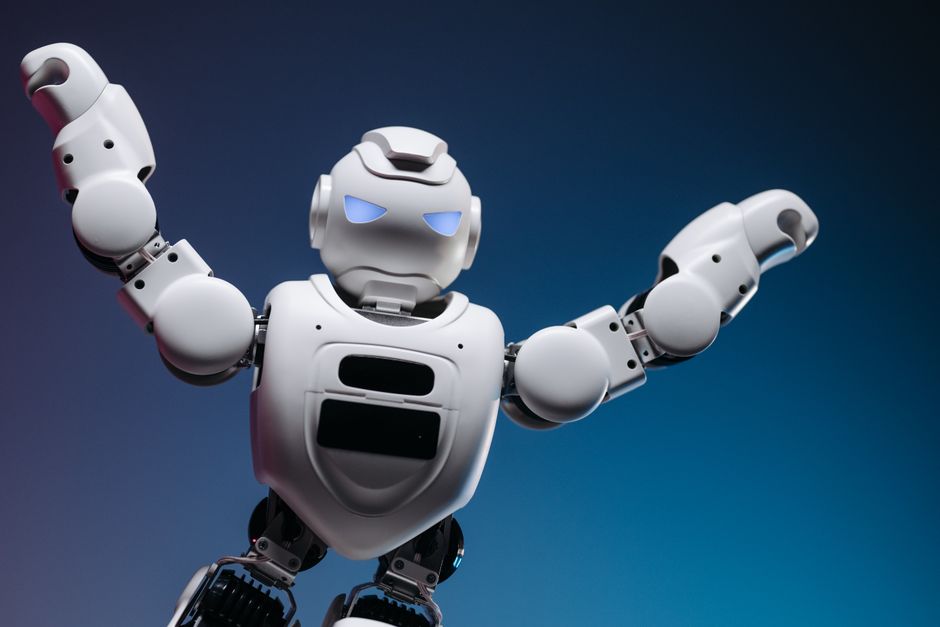
Imagine a robot that learns to navigate a maze not by being explicitly programmed with every turn, but by simply trying, failing, and eventually succeeding – much like how a child learns to walk or ride a bicycle. This isn't science fiction anymore; it's the fascinating world of Reinforcement Learning (RL) in robotics, a powerful technique that allows robots to learn optimal behaviors through interaction with their environment. At MakerWorks, we believe understanding these cutting-edge concepts is key to shaping the innovators of tomorrow, and today, we're diving deep into how robots are being trained to make their own smart decisions.
What is Reinforcement Learning? The Robot's School of Hard Knocks
At its core, Reinforcement Learning is a type of machine learning where an "agent" (our robot, in this case) learns to perform actions in an "environment" to maximize a cumulative "reward." Think of it like training a pet: when your dog sits on command, you give it a treat (a positive reward). If it jumps up, you might ignore it (no reward, or a subtle negative signal). Over time, the dog learns to associate sitting with treats and performs that action more often.
In the world of robots, this translates to:
- The Agent: The robot itself.
- The Environment: The physical space or simulated world the robot operates in (e.g., a factory floor, a cluttered room, a virtual maze).
- State: The current situation or configuration of the environment, observed by the robot (e.g., its position, the distance to an obstacle, the color of an object).
- Action: What the robot can do (e.g., move forward, turn left, grasp an object, change speed).
- Reward: A numerical feedback signal from the environment, indicating how good or bad the robot's action was. Positive rewards encourage desired behaviors, while negative rewards (penalties) discourage undesirable ones.
"Reinforcement Learning is about learning what to do—how to map situations to actions—so as to maximize a numerical reward signal." - Richard S. Sutton and Andrew G. Barto, "Reinforcement Learning: An Introduction"
How Do Robots Learn with RL? The Trial-and-Error Journey
Unlike traditional programming where every step is explicitly defined, RL robots learn through a process of trial and error. Here's a simplified breakdown:
1. Exploration and Exploitation
Initially, a robot doesn't know what actions are best. It starts by exploring its environment, trying different actions randomly. For example, a robot learning to walk might fall countless times. Each fall is a "negative reward" or penalty, and successfully taking a step is a "positive reward."
As it gathers more experience, the robot starts to "exploit" what it has learned, favoring actions that have led to higher rewards in the past. It's a continuous balance between trying new things (exploration) and using what works best (exploitation).
2. The Reward System: Guiding Behavior
Designing an effective reward system is crucial. If a robot is learning to pick up a specific block, a positive reward might be given when it successfully grasps the block and places it in a designated bin. A negative reward could be given if it drops the block or hits an obstacle.
The robot's goal is to learn a "policy" – a strategy that tells it which action to take in any given state to maximize its total expected future reward.
3. Value Functions and Q-Tables
To make smart decisions, the robot needs to estimate the "value" of being in a particular state or taking a particular action from a state. This is where value functions come in. A common technique is using a Q-table (Q-learning), which stores the expected future reward for taking each action in each state.
Let's imagine a tiny robot navigating a 2x2 grid to find a treasure. The robot can move Up, Down, Left, Right. The treasure gives a +10 reward, and falling off the grid gives -5. All other moves give -1.
# Simplified Q-table concept for a robot in a 2x2 grid
# Q[state, action] = estimated_future_reward

# Initial Q-table (all zeros)
Q = {
    (row0, col0): {'Up': 0, 'Down': 0, 'Left': 0, 'Right': 0},
    (row0, col1): {'Up': 0, 'Down': 0, 'Left': 0, 'Right': 0},
    (row1, col0): {'Up': 0, 'Down': 0, 'Left': 0, 'Right': 0},
    (row1, col1): {'Up': 0, 'Down': 0, 'Left': 0, 'Right': 0}
}

# Example of a robot learning:
# Robot is at (row0, col0). It tries 'Right'.
# It moves to (row0, col1). Reward = -1.
# It updates Q[(row0, col0), 'Right'] based on this experience.

# Later, if (row1, col1) is the treasure:
# Robot is at (row0, col1). It tries 'Down'.
# It moves to (row1, col1) (treasure!). Reward = +10.
# It updates Q[(row0, col1), 'Down'] to reflect this high reward.

# Over many trials, the Q-table fills up, guiding the robot to take the
# action with the highest Q-value from its current state.
This Q-table, or more complex neural network models in advanced RL, helps the robot predict the best course of action without needing explicit instructions for every possible scenario.
Why is Reinforcement Learning a Game-Changer for Robotics?
- Autonomous Decision Making: Robots can learn to make decisions on their own, adapting to unforeseen circumstances without human intervention.
- Adapting to Dynamic Environments: Unlike static programming, RL allows robots to adjust their behavior in environments that change, such as a factory floor with moving obstacles or a home with rearranged furniture.
- Solving Complex Tasks: RL can tackle problems that are too complex or impractical to program manually, like learning intricate manipulation skills or navigating highly variable terrain.
- Learning from Experience: Just like humans, RL robots get better with practice. The more data and interaction they have, the more refined their skills become.
Real-World Applications: RL Robots in Action
Reinforcement Learning is already transforming various fields:
- Robotic Arm Manipulation: Robots are learning to pick and place delicate objects, assemble complex parts, and even perform surgical tasks with greater precision and adaptability. Imagine a robot in an Indian factory learning to sort different types of spices or fabrics.
- Autonomous Navigation: Self-driving cars, delivery drones, and warehouse robots use RL to navigate complex environments, avoid obstacles, and plan optimal routes.
- Robot Locomotion: Bipedal (two-legged) and quadrupedal (four-legged) robots are using RL to learn to walk, run, and balance on uneven terrain, making them more agile and robust.
- Human-Robot Interaction: RL helps robots understand and respond to human cues, leading to more natural and intuitive collaboration in homes and workplaces.
- Industrial Automation: Optimizing manufacturing processes, scheduling tasks, and managing resources more efficiently.
The Future is Learning: What's Next for RL in Robotics?
The journey of Reinforcement Learning in robotics is just beginning. We can expect to see:
- More General-Purpose Robots: Robots that can learn a wide range of skills and transfer knowledge from one task to another, much like humans.
- Safer Human-Robot Collaboration: RL will enable robots to predict human intentions and react safely and effectively in shared spaces.
- Robots in Challenging Environments: From deep-sea exploration to disaster relief, RL will empower robots to operate autonomously in environments too dangerous or inaccessible for humans.
- Personalized Robotics: Robots that adapt to individual user preferences and learn unique behaviors based on personal interaction.
Embark on Your Own RL Journey with MakerWorks!
Reinforcement Learning is a powerful testament to how artificial intelligence is enabling robots to move beyond pre-programmed instructions and truly learn from their experiences. It's a field brimming with innovation and potential, offering exciting challenges and opportunities for young minds like yours.
At MakerWorks, we believe in empowering the next generation of innovators. Understanding concepts like Reinforcement Learning is not just about robots; it's about developing problem-solving skills, computational thinking, and a curiosity for how the world works. Are you ready to dive deeper into the world of robotics and AI?
Explore our courses, workshops, and resources at makerworkslab.in, and start building the future, one intelligent robot at a time. Who knows, perhaps your next project will be a robot that learns entirely on its own!