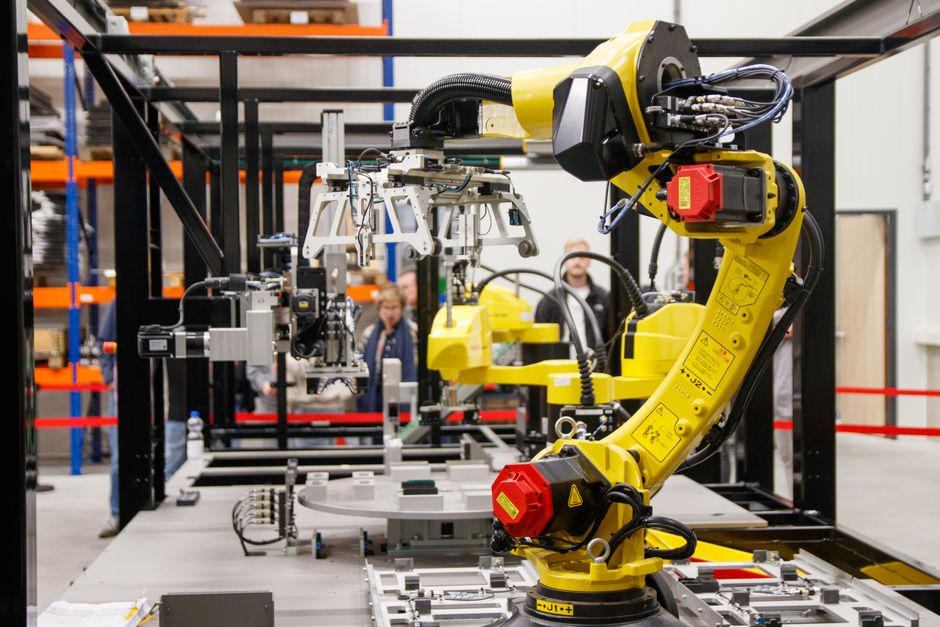
Imagine a factory floor where machines work tirelessly, with precision that never falters, assembling cars, packaging food, or even crafting the smartphones we use every day. This isn't science fiction; it's the reality brought to life by industrial robots and automation, a revolution reshaping manufacturing across India and the globe. These mechanical marvels are the backbone of modern industries, enhancing efficiency, safety, and quality at an unprecedented scale. Join us as we explore the fascinating world of industrial robotics, understanding how these intelligent machines are driving progress and what it means for our future.
What are Industrial Robots?
At its core, an industrial robot is an automatically controlled, reprogrammable, multi-purpose manipulator programmable in three or more axes. In simpler terms, think of them as highly advanced mechanical arms or systems designed to perform specific tasks repeatedly and precisely in industrial settings. They are built for endurance, accuracy, and speed, often taking on jobs that are too dangerous, monotonous, or physically demanding for humans.
Key Characteristics of Industrial Robots:
- Precision: They can perform tasks with incredible accuracy, ensuring consistent product quality.
- Repeatability: They can repeat the same motion sequence thousands or millions of times without deviation.
- Speed: Many industrial robots operate at very high speeds, significantly reducing production times.
- Endurance: Unlike humans, robots don't get tired and can work 24/7 in harsh environments.
- Flexibility: They can be reprogrammed to perform different tasks, making them versatile assets in a factory.
Types of Industrial Robots
Just like tools, robots come in various shapes and sizes, each designed for specific applications. Here are some of the most common types you'll find in factories today:
Articulated Robots
These are perhaps the most common and recognizable industrial robots, often resembling a human arm. They have rotary joints (axes) and can range from two to ten or more axes. The more axes, the greater their flexibility and range of motion. They are incredibly versatile and used for tasks like welding, material handling, machine tending, and painting.
SCARA Robots (Selective Compliance Assembly Robot Arm)
SCARA robots are known for their fast and precise movements on a horizontal plane. They typically have four axes, with two parallel rotary joints providing compliance in a specific direction. This makes them ideal for high-speed pick-and-place operations, assembly, and packaging tasks, particularly in electronics manufacturing.
Delta Robots (Parallel Robots)
These robots are unique in their design, featuring three arms connected to a single base, forming a parallel kinematic structure. Delta robots are famous for their extremely high speed and precision, especially when handling light loads. They are often seen in food packaging, pharmaceutical, and electronic assembly lines, rapidly sorting and placing items.
Cartesian Robots (Gantry Robots)
Cartesian robots move along three linear axes (X, Y, and Z), much like a 3D printer or a CNC machine. They are known for their rigidity, precision, and ability to handle heavy payloads over large workspaces. They are commonly used for tasks requiring linear motion, such as dispensing, pick-and-place, and material handling in large-scale manufacturing.
Collaborative Robots (Cobots)
Cobots are a newer and exciting development in robotics. Unlike traditional industrial robots that operate behind safety fences, cobots are designed to work safely alongside humans. They often have built-in safety features like force sensors that stop them if they encounter resistance. Cobots are perfect for tasks requiring human-robot collaboration, such as assembly, inspection, and machine loading, making automation accessible to smaller businesses too.
Where Do We Find Them? Applications in India and Beyond
Industrial robots are no longer confined to sci-fi movies; they are integral to various industries worldwide, including India's rapidly growing manufacturing sector. Here are some key applications:
- Automotive Industry: From welding car chassis to painting body panels and assembling intricate components, robots are indispensable in car manufacturing plants. Major players in India like Tata Motors, Maruti Suzuki, and Mahindra use extensive robotic automation.
- Electronics Manufacturing: For assembling tiny components on circuit boards, testing devices, and packaging electronics, SCARA and Delta robots provide the necessary speed and precision.
- Food & Beverage: Robots handle everything from sorting fresh produce to packaging biscuits, bottling beverages, and palletizing heavy crates, ensuring hygiene and efficiency.
- Pharmaceuticals: In sterile environments, robots perform tasks like lab automation, drug dispensing, and packaging, minimizing contamination risks.
- Logistics & Warehousing: Automated guided vehicles (AGVs) and robotic arms sort packages, pick items from shelves, and load trucks, speeding up supply chains.
- Metal Fabrication: Robots perform precise cutting, bending, and welding of metal parts, crucial for construction and heavy machinery industries.
"The future of manufacturing is not about replacing humans with robots, but about empowering humans with robots. Automation frees us from monotonous tasks, allowing us to focus on innovation, creativity, and problem-solving."
How Do Industrial Robots Work? The Brains and Brawn
An industrial robot is a complex system working in harmony. Let's break down its key components:
- Manipulator (The Arm): This is the physical structure of the robot, typically made of strong, lightweight materials, with multiple joints (axes) that allow it to move in different directions.
- End-Effector (The Hand): Attached to the end of the manipulator, this is the tool that interacts with the work environment. It could be a gripper, a welding torch, a paint sprayer, a vacuum suction cup, or even a camera for inspection.
- Controller (The Brain): This is the computer system that stores the robot's programs and controls its movements. It sends signals to the motors in each joint, ensuring the robot follows its programmed path precisely.
- Sensors: Robots often use various sensors (vision systems, force sensors, proximity sensors) to perceive their environment, detect objects, measure forces, and ensure safety.
Programming Industrial Robots
Robots need instructions to perform tasks. These instructions are called programs. There are several ways to program a robot:
- Teach Pendant: A handheld device with buttons and a screen, allowing an operator to manually move the robot to desired points and record those positions.
- Offline Programming: Software is used to simulate the robot's movements and create programs on a computer, without needing to stop the actual production line.
- Lead-through Programming: For cobots, an operator can physically guide the robot arm through the desired motions, which the robot then records and repeats.
Here's a simplified pseudo-code example for a basic pick-and-place operation, illustrating how a robot might be programmed:
// Simplified pseudo-code for a pick-and-place robot task

// Define variables for positions
DEFINE HOME_POSITION = (0, 0, 0, 0, 0, 0) // Joint angles or XYZ coordinates
DEFINE PICK_APPROACH_POSITION = (X1, Y1, Z_APPROACH_PICK)
DEFINE PICK_POSITION = (X1, Y1, Z_PICK)
DEFINE PLACE_APPROACH_POSITION = (X2, Y2, Z_APPROACH_PLACE)
DEFINE PLACE_POSITION = (X2, Y2, Z_PLACE)

// Main Program Sequence
START PROGRAM
    SET SPEED = MEDIUM // Set robot's operational speed
    MOVE TO HOME_POSITION // Go to a safe starting position

    LOOP FOREVER // Robot continuously performs the task
        // --- Pick up item ---
        MOVE TO PICK_APPROACH_POSITION // Move above the item
        MOVE TO PICK_POSITION // Descend to the item's level
        CLOSE GRIPPER // Actuate the end-effector to grasp the item
        WAIT 0.5 SECONDS // Allow gripper to fully close
        MOVE TO PICK_APPROACH_POSITION // Lift the item

        // --- Place item ---
        MOVE TO PLACE_APPROACH_POSITION // Move above the destination
        MOVE TO PLACE_POSITION // Descend to the placement level
        OPEN GRIPPER // Release the item
        WAIT 0.5 SECONDS // Allow gripper to fully open
        MOVE TO PLACE_APPROACH_POSITION // Lift the gripper

        // Optional: Return to home or wait for next command
        // MOVE TO HOME_POSITION
    END LOOP

END PROGRAM
The Impact of Automation: Benefits and Challenges
Industrial robotics brings transformative changes, offering numerous advantages but also presenting new challenges.
Benefits:
- Increased Productivity: Robots work faster and continuously, leading to higher output.
- Improved Quality: Their precision ensures consistent product quality and reduces defects.
- Enhanced Safety: Robots can perform dangerous tasks in hazardous environments, protecting human workers.
- Cost Reduction: While initial investment is high, robots reduce labor costs, waste, and energy consumption in the long run.
- Flexibility: Easily reprogrammable, they can adapt to new product designs or tasks quickly.
Challenges:
- High Initial Investment: Setting up robotic systems requires significant capital.
- Skilled Workforce Requirement: Operating and maintaining robots requires specialized skills, creating a demand for new talent.
- Job Displacement Concerns: While robots create new jobs (programmers, maintenance technicians), they can displace workers in repetitive tasks. It's a shift in the type of jobs available, requiring reskilling.
- Complexity: Designing, integrating, and troubleshooting complex robotic systems can be challenging.
The Future of Industrial Robotics in India
India is on the cusp of a major industrial transformation, with the "Make in India" initiative driving increased adoption of automation. The future of industrial robotics here is bright, characterized by:
- Smart Factories: Integration with Artificial Intelligence (AI), Machine Learning (ML), and the Internet of Things (IoT) will lead to highly autonomous and optimized "smart factories."
- Mobile Robotics: More mobile robots (like AGVs and AMRs - Autonomous Mobile Robots) will work alongside stationary ones for material transport.
- Advanced Sensing: Robots will become even more perceptive with advanced vision, haptic (touch), and auditory sensors.
- Human-Robot Collaboration: Cobots will become more prevalent, fostering a collaborative work environment where humans and robots augment each other's strengths.
- Skill Development: A strong emphasis on STEM education and vocational training will be crucial to prepare the workforce for these advanced roles.
Conclusion
Industrial robots and automation are not just machines; they are catalysts for progress, driving innovation and efficiency across industries. From the precision of a SCARA robot assembling electronics to the collaborative efforts of a cobot working alongside a human, these technologies are defining the future of manufacturing. For young minds in India, understanding and engaging with robotics opens up a world of exciting career opportunities in engineering, programming, maintenance, and design. The factories of tomorrow are being built today, and you have the chance to be a part of this incredible journey.
Ready to dive deeper into the world of robotics? Explore the resources at MakerWorks, join our workshops, and start building your own robotic projects. The future is automated, and it's waiting for you to innovate!