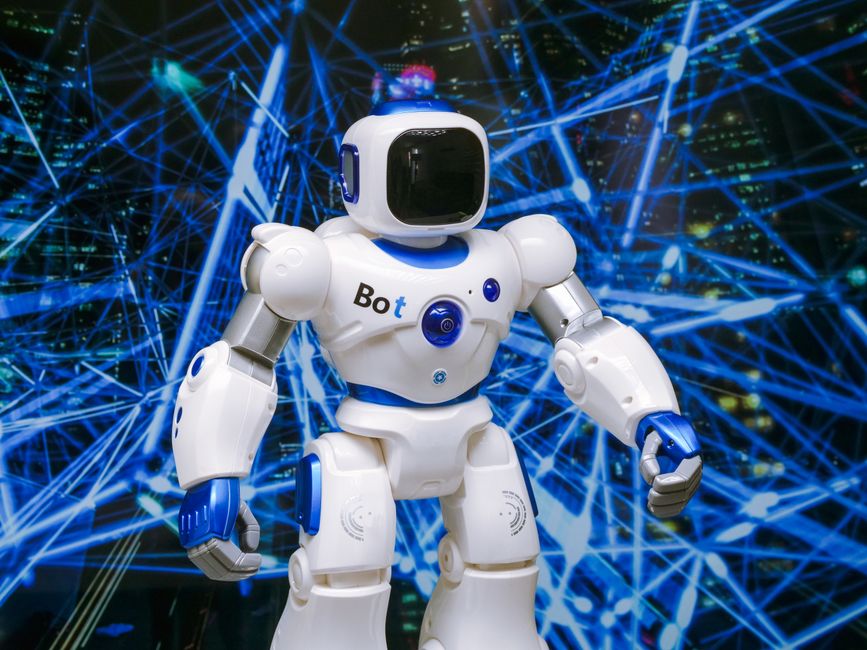
Imagine a world where robots don't just follow instructions, but actually think, learn, and adapt – much like us! This isn't science fiction anymore; it's the exciting reality unfolding right before our eyes, thanks to Artificial Intelligence (AI) merging with Robotics. From self-driving cars navigating bustling Indian streets to smart factory robots revolutionizing manufacturing, AI is transforming how robots perceive, interact with, and understand our world. Join us on a journey to explore how these incredible technologies are coming together to create the next generation of intelligent machines, and what it means for innovators like you in India!
What is AI in Robotics?
At its core, Artificial Intelligence is about making machines intelligent – giving them the ability to "think" and "reason" like humans. When we combine AI with robotics, we're not just building machines that can move; we're creating robots that can:
- Perceive: Understand their surroundings using sensors (cameras, microphones, touch sensors).
- Reason: Process information, make decisions, and solve problems.
- Learn: Improve their performance over time through experience, without explicit programming for every single scenario.
- Act: Perform physical tasks based on their perceptions and decisions.
Think of it this way: a traditional robot is like a meticulously programmed puppet, performing only the steps it's told. An AI-powered robot, however, is more like a student – it learns, adapts, and can even figure out new ways to achieve its goals, making it a truly "smart robot."
The Brains Behind the Bots: Key AI Concepts
To make robots smart, engineers and scientists use several powerful AI techniques. Let's break down some of the most important ones:
Machine Learning (ML)
Machine Learning is a subset of AI that allows systems to learn from data without being explicitly programmed. Instead of writing rules for every possible situation, we "train" the robot by showing it lots of examples. Imagine teaching a robot to identify a cup:
- Supervised Learning: We show it thousands of pictures of cups (and non-cups), telling it "this is a cup," "this is not a cup." The robot learns to recognize cups on its own.
- Unsupervised Learning: The robot looks at a bunch of objects and tries to find patterns or group similar items together without any prior labels.
- Reinforcement Learning: This is like training a pet with rewards. The robot performs an action, and if it's a good outcome, it gets a "reward" (positive feedback); if bad, a "penalty." Over time, it learns which actions lead to the best outcomes. This is crucial for robots learning to navigate complex environments or play games.
Neural Networks and Deep Learning
Inspired by the human brain, Artificial Neural Networks (ANNs) are a core component of many modern AI systems. They consist of interconnected "neurons" (mathematical functions) organized in layers. When data (like an image from a robot's camera) is fed into the network, it passes through these layers, and each neuron processes a tiny piece of information, eventually leading to an output (e.g., "This is a human face").
Deep Learning is a type of Machine Learning that uses very large neural networks with many layers (hence "deep"). This allows robots to learn incredibly complex patterns, making them excellent at tasks like:
- Recognizing objects and people (Computer Vision).
- Understanding speech (Natural Language Processing).
- Predicting outcomes.
Computer Vision
How do robots "see"? With Computer Vision! This field of AI enables robots to interpret and understand visual information from the real world, just like our eyes and brain do. A robot equipped with cameras and computer vision algorithms can:
- Detect objects (e.g., an obstacle, a tool, a person).
- Recognize faces and expressions.
- Map its surroundings.
- Track movement.
This is vital for autonomous navigation, inspection, and interaction with humans.
Natural Language Processing (NLP)
If you've ever asked Siri, Alexa, or Google Assistant a question, you've used NLP. This AI branch allows computers to understand, interpret, and generate human language. For robots, NLP means they can:
- Understand spoken commands.
- Respond to questions in natural language.
- Process text-based information.
This makes human-robot interaction much more intuitive and natural.
How AI is Making Robots Smarter: Real-World Applications
The combination of AI and robotics is leading to groundbreaking innovations across various sectors:
- Autonomous Vehicles and Drones: Self-driving cars, delivery drones, and even autonomous agricultural vehicles use AI for navigation, obstacle detection, and decision-making in real-time. Imagine drones delivering medicines to remote villages in India!
- Industrial Automation: In factories, AI-powered robots are not just performing repetitive tasks; they are learning to adapt to changes in production lines, performing complex assembly, and conducting quality control inspections with incredible precision.
- Healthcare: AI helps surgical robots perform delicate procedures with superhuman precision. Assistive robots can help the elderly or people with disabilities, and AI can even aid in diagnosis by analyzing medical images.
- Exploration: Robots like NASA's Mars rovers use AI to navigate unfamiliar terrain, identify interesting geological features, and make scientific decisions autonomously, billions of miles away from Earth.
- Service and Education: From robotic waiters in restaurants to companion robots for children and the elderly, AI is enabling robots to interact more naturally and provide personalized services. Educational robots can adapt their teaching methods based on a student's learning pace.
- Logistics and Warehousing: AI-driven robots sort packages, move inventory, and optimize routes in large warehouses, significantly increasing efficiency and speed.
A Peek Under the Hood: Simple AI Logic
Even complex AI systems are built upon foundational logic. Let's look at a very simple example of how a robot might use a basic "if-then" AI rule to navigate:
# This is a simplified example of a robot's decision-making logic
# In a real robot, 'sensor_data' would come from actual sensors

def robot_decision_maker(sensor_data):
    if sensor_data["distance_front"] < 20: # If obstacle is less than 20 units away
        print("Obstacle detected! Turning right.")
        # Command robot to turn right
        return "TURN_RIGHT"
    elif sensor_data["light_level"] < 50: # If it's getting dark
        print("Low light detected. Activating headlights.")
        # Command robot to turn on headlights
        return "ACTIVATE_HEADLIGHTS"
    else:
        print("Path clear. Moving forward.")
        # Command robot to move forward
        return "MOVE_FORWARD"

# Simulate sensor data
current_sensor_data = {
    "distance_front": 35,
    "light_level": 70
}

# Robot makes a decision
robot_action = robot_decision_maker(current_sensor_data)
print(f"Robot's chosen action: {robot_action}")

# Simulate new sensor data (e.g., robot moved closer to an obstacle)
new_sensor_data = {
    "distance_front": 15,
    "light_level": 60
}

robot_action_new = robot_decision_maker(new_sensor_data)
print(f"Robot's chosen action: {robot_action_new}")
In this Python example, the robot_decision_maker function acts like a tiny brain. It takes information from "sensors" (simulated here as sensor_data) and makes a decision based on simple rules. If it senses an obstacle too close, it decides to turn. If it's getting dark, it activates headlights. Otherwise, it keeps moving forward. Real AI systems use much more complex algorithms, but the fundamental idea of processing input to make intelligent decisions remains the same.
The Future is Now: Challenges and Opportunities
While the potential of AI in robotics is immense, there are challenges to address:
- Data Dependency: AI models often require vast amounts of data to learn effectively.
- Computational Power: Training and running complex AI models demand significant processing power.
- Ethics and Safety: Ensuring AI-powered robots operate safely, fairly, and ethically is paramount. Who is responsible if an autonomous robot makes a mistake?
- Explainability: Sometimes, it's hard to understand why a complex AI model made a particular decision ("black box problem").
"The real question is not whether machines think, but whether men do." – B.F. Skinner
This quote reminds us that while we push the boundaries of machine intelligence, our own critical thinking and ethical considerations are more important than ever.
Despite these challenges, the opportunities are even greater. AI in robotics can help us solve some of the world's most pressing problems, from climate change and disaster response to healthcare and education. It's an exciting field that promises to create new industries and job roles, especially for a tech-forward nation like India.
Why This Matters for You (Especially in India!)
India is rapidly becoming a global hub for technology and innovation. With initiatives like "Make in India" and a booming startup ecosystem, the demand for skilled professionals in AI, robotics, and related STEM fields is skyrocketing. Learning about AI in robotics now isn't just about understanding the future; it's about actively shaping it. Whether you're a student dreaming of building the next generation of smart devices, an educator looking to inspire young minds, or an enthusiast keen on exploring new frontiers, the skills you gain in these areas will be invaluable.
Conclusion
Artificial Intelligence is no longer just a buzzword; it's the intelligence that powers the next generation of robots, turning them from simple machines into capable, adaptable, and increasingly autonomous companions and tools. From the factory floor to the operating theatre, and from distant planets to our very homes, smart robots are redefining what's possible. The journey of AI in robotics is just beginning, and with every byte of data and every line of code, we are building a future where machines can not only assist us but also learn, grow, and innovate alongside us.
Are you ready to be part of this revolution? Dive into the world of AI and robotics! Explore, experiment, and build. At MakerWorks, we believe in empowering the next generation of innovators. Check out our workshops, courses, and resources to start your journey today. The future of robotics is intelligent, and it's waiting for you to create it!